
Last updated November 17, 2026
 AC repair
 Furnace & heating
 Heat pumps
 Ductless mini splits
 Carrier
 Trane
 Goodman
Seasonal tune-up and full diagnostic on your Carrier, Trane, or Goodman system - readings shown to you before any repair is proposed
Diagnosis first, numbers second - you approve the repair price before a single part goes in.
Get your free estimateAC Repair & Installation Maintenance Checklist for Enterprise Homeowners
The checklist your last HVAC company left on the fridge has seventeen items. Eleven of them are legally required to be on there. Only four of them are specific to your house. That’s the problem. A generic list baked into a software template will check a box for the contractor and tell you almost nothing about the Carrier or Trane system sitting in your backyard. This guide is built the other way around: what actually fails first on homes in Enterprise, and what month it tends to happen here. You’ll learn a month-by-month calendar that matches our weather, how to spot a band-aid quote, and what you can verify yourself after a visit.
Quick Answer
A real AC maintenance checklist for an Enterprise home should be tied to our actual season: pre-summer cooling checks in March and April, dust and duct infiltration checks through the windy spring, and a coil and drain-line review before the July heat settles in. The checklist should list what was tested, the readings, and the parts condition, not just checkmarks. If your list has no numbers on it, you don’t have a maintenance record. You have a receipt.
Styles & brands we work with
- AC repair
- Furnace & heating
- Heat pumps
- Ductless mini splits
- Carrier
- Trane
- Goodman
Table of Contents
- The Month-by-Month Checklist for Enterprise Weather
- Dust Infiltration and the Construction Boom
- How to Tell if a Repair Quote Is Band-Aiding a Dying System
- What You Can Physically Verify After a Maintenance Visit
- The Three Tasks Most Maintenance Contracts Quietly Skip
- Installation and Replacement: What the Checklist Should Look Like
- What This Work Costs in Enterprise
- When to Call a Professional
The Month-by-Month Checklist for Enterprise Weather
Most checklists split the year into “spring” and “fall.” That split was written for a climate with four distinct seasons, and it doesn’t fit Enterprise. Our cooling season runs long, our shoulder months are short, and the stretch from May to September is where systems actually break. Here’s the calendar we use when we walk into an Enterprise house.
- March: Test the system in cooling mode before you need it. Confirm the condenser contactor pulls in cleanly, check the capacitor with a meter (not by eye), and clear any debris the winter winds packed against the condenser pad. This is the month to catch a weak capacitor before a 108-degree afternoon catches it for you.
- April: Change the filter and inspect the return grille for dust loading. Wash the condenser coil if it’s visibly dirty. Confirm the float switch in the drain pan is working, because a clogged condensate line in April becomes a ceiling stain in July.
- May: Full check of refrigerant pressures and superheat or subcooling, and a look at the blower wheel for dust buildup. Look at the outdoor disconnect and the whip for sun-cracked insulation.
- June through August: Filter changes every 30 days if you have pets or you’re near active construction. Visual check of the drain line and pan. Listen to the outdoor fan – a bearing starting to fail has a sound you can catch early.
- September: Post-season review. Look at the capacitor reading again, because summer is what wears them out. Clean the coil one more time before the fall dust arrives.
- October and November: If you have a heat pump, this is when the reversing valve and defrost cycle get tested. If you have a furnace, the heat exchanger inspection and burn test happen here.
Notice that the heavy cooling work happens in March and April, not June. By the time the first 105-degree day hits Enterprise, a system that was marginal in March is a service call in June. Getting ahead of that one month is the whole point of a calendar instead of a spring/fall split.
Dust Infiltration and the Construction Boom
Enterprise has been building fast, and new roads, graded lots, and active construction sites move a lot of particulate into the air between March and June. That dust doesn’t just settle on your patio furniture. It gets pulled into the return, loads the filter in half the time a manufacturer’s chart suggests, and coats the blower wheel and evaporator coil. When a blower wheel is packed with dust, airflow drops, and the system runs longer and hotter to move the same air.
If you’re in one of the newer neighborhoods where lots are still being graded nearby, your filter interval is not “every three months.” It’s every 30 days during the dusty stretch, and you should physically hold the filter up to the light. If you can’t see light through it, it was done a week ago. Here’s what to check on a home near active construction:
- Return grille: pull it off and look at the dust mat on the filter face. Heavy gray buildup means you’re behind.
- Condenser pad: check for dust and fine grit packed into the coil fins. A garden hose rinse (power off at the disconnect first) clears the loose dust before it bakes on.
- Door and window seals: dusty air gets pulled in through gaps in the envelope, not just the return. A quick pass with weatherstripping reduces the load on the filter.
- Attic and crawlspace penetrations: any gap where ductwork passes through the ceiling should be sealed. This is one of the most common infiltration points in Enterprise homes near new construction.
We’ve seen filters in these neighborhoods load up in three weeks flat during heavy grading activity. That’s not a filter problem. That’s a house telling you the dust load in your specific area is higher than the generic chart assumes.
How to Tell if a Repair Quote Is Band-Aiding a Dying System
This is the math we actually run on a service call. A repair quote is only honest if it’s compared to what a replacement would cost over the same number of years. Here’s the rule of thumb we use, and you can run it yourself.
- Get the age of the system. Most split systems are built to run 12 to 15 years in a climate like Enterprise. If your unit is past 12 and this is the second big repair, the math gets tight fast.
- Get the repair cost. A compressor replacement on a 13-year-old system often runs $1,200 to $2,000 depending on size and brand. A capacitor is $150 to $350. Those are very different decisions.
- Multiply the repair by the years you’ll realistically keep the system. If the system has maybe three years left and the repair is $1,800, you’re paying $600 a year to keep a dying system alive. New equipment with a warranty and lower operating cost usually wins that comparison.
- Check the refrigerant type. Older R-22 systems face higher recharge costs and shrinking supply. If your system uses R-22 and needs refrigerant, that alone can tip the decision toward replacement.
The band-aid signal is a quote that replaces a part without addressing why it failed. A compressor that died because the capacitor was weak, the coil was dirty, and the system was running hot will fail again on the new compressor unless someone fixes the cause. We test the capacitor before anyone says the word compressor, and the readings go on the invoice so you can see the reasoning.
What You Can Physically Verify After a Maintenance Visit
You don’t need gauges and a meter to confirm the person at your door did what the invoice says. You need about ten minutes and a flashlight. Here’s a short list of things a homeowner can check after the visit, and what “done right” looks like on each one.
- The filter: pull it out and hold it to the light. If it’s still loaded with dust, it wasn’t changed, and that’s a red flag for everything else on the list.
- The condensate drain: pour a cup of water into the pan and watch it drain. Slow draining means the line wasn’t cleared.
- The condenser coil: look at the fins from the outside. They should be visibly cleaner than they were before. If the invoice says “coil cleaned” and the fins are still gray, ask.
- The readings on the invoice: a real maintenance record lists the capacitor microfarad reading, the amp draw, and the refrigerant pressures. If none of those numbers are on the paperwork, the “inspection” was a visual walk-around.
- The disconnect and whip: look at the outdoor electrical connections. Sun-cracked insulation or loose fittings should have been flagged to you, not quietly ignored.
We bring the readings back to you because that’s the whole point of a maintenance visit – you should know what your system measured, not just that someone was here. If a company hands you a checklist with nothing but checkmarks and no numbers, that’s a liability document, not a service record.
The Three Tasks Most Maintenance Contracts Quietly Skip
Maintenance agreements are priced to fit a schedule window, and three tasks routinely get cut because they take time and nobody’s standing there watching. Ask for these by name when you book, and confirm on the invoice that they happened.
- Blower wheel cleaning. Pulling the blower assembly, cleaning the wheel, and reinstalling it takes real time. Most “maintenance” visits look at it through the grille and move on. A dust-loaded wheel cuts airflow and drives up your electric bill, and it’s one of the first things to fail on a dusty Enterprise property.
- Full condenser coil deep clean. A hose rinse is not a deep clean. If the coil has years of baked-on dust and cottonwood, it needs a coil cleaner and a proper rinse, and that’s a longer job than a surface spray.
- Duct leakage check on accessible runs. A visual glance at the accessible duct in the attic or crawlspace is not a leakage check. It means feeling for air movement at the joints and taping or sealing the obvious leaks. In Enterprise homes with attic runs, this can be worth 10 to 20 percent of your cooling cost.
None of these are exotic. They’re just time-consuming, and time is what gets cut when a schedule is packed. You’re allowed to ask for them explicitly, and any honest company will tell you what’s included and what’s an add-on before the visit.
Installation and Replacement: What the Checklist Should Look Like
Installation is not a maintenance item, and the checklist for a new system is a different document entirely. A proper replacement involves a load calculation for your specific house, a duct review, a line-set and electrical evaluation, and a startup report with the same readings a maintenance visit would produce. If you’re comparing quotes, look for these:
- A load calculation, not a rule of thumb. “Same size as the old one” is not a load calculation. House envelope, window area, and insulation all change what size you actually need.
- A duct condition report. New equipment pushed through leaky ducts loses efficiency before it reaches a room.
- Startup readings: refrigerant charge, static pressure, and amp draw on the new equipment. If the installer doesn’t leave these, the job isn’t finished.
- A written fixed price and a set install date. Installation is scheduled work. Any company promising same-day replacement is either cutting the load calculation or installing the wrong size.
We install Carrier, Trane, Lennox, and American Standard systems, and the startup report we leave behind uses the same readings-first approach whether the job was a $300 repair or a full replacement. That record is what a second company would need if you ever wanted a second opinion. Which you should get. Our AC repair and installation in Enterprise page covers what that process looks like in detail, and our Ray’s Heating & Air Enterprise home page is the place to start if you’re new to us.
What This Work Costs in Enterprise
Pricing varies with equipment size and condition, but here are the ranges we see on a typical Enterprise service call so you have a benchmark before anyone hands you a number.
- Seasonal maintenance visit: $120 to $220, typically including filter, coil check, drain clear, and a written readings report.
- Capacitor replacement: $150 to $350 installed, after a meter test – not a guess.
- Contactor replacement: $180 to $320 installed.
- Condensate drain line clear: $120 to $250, depending on access.
- Refrigerant recharge (R-410A): $150 to $400 depending on the amount needed and whether a leak was found.
- Full system replacement: $5,500 to $11,000 depending on size, efficiency tier, and whether duct work is included.
One standing offer worth knowing about: a Free Second Opinion on any written estimate. If a company hands you a replacement quote, we’ll look at it and tell you honestly whether the math holds up. That’s also why we publish readings before numbers – a quote you can’t verify isn’t a quote, it’s a demand. There’s also a $40 off any repair over $200 and a 10 percent discount for seniors and veterans, and no trip charge inside the county.
When to Call a Professional
Some things on this checklist are homeowner tasks: changing a filter, checking the return grille, rinsing a condenser coil with the power off. Others are not. Refrigerant work requires a license and a recovery machine. Capacitor and contactor testing involves live 240-volt components, and getting it wrong can hurt you or damage the equipment. Nobody should be poking around inside a condenser cabinet without training and the right meter. If the system is short-cycling, blowing warm air, leaking water, or making a sound it didn’t make last week, that’s a call, not a project. Ray’s Heating & Air Enterprise offers free estimates in Enterprise – call (844) 455-2034. No trip charge inside the county, and a live person answers around the clock.
See the difference
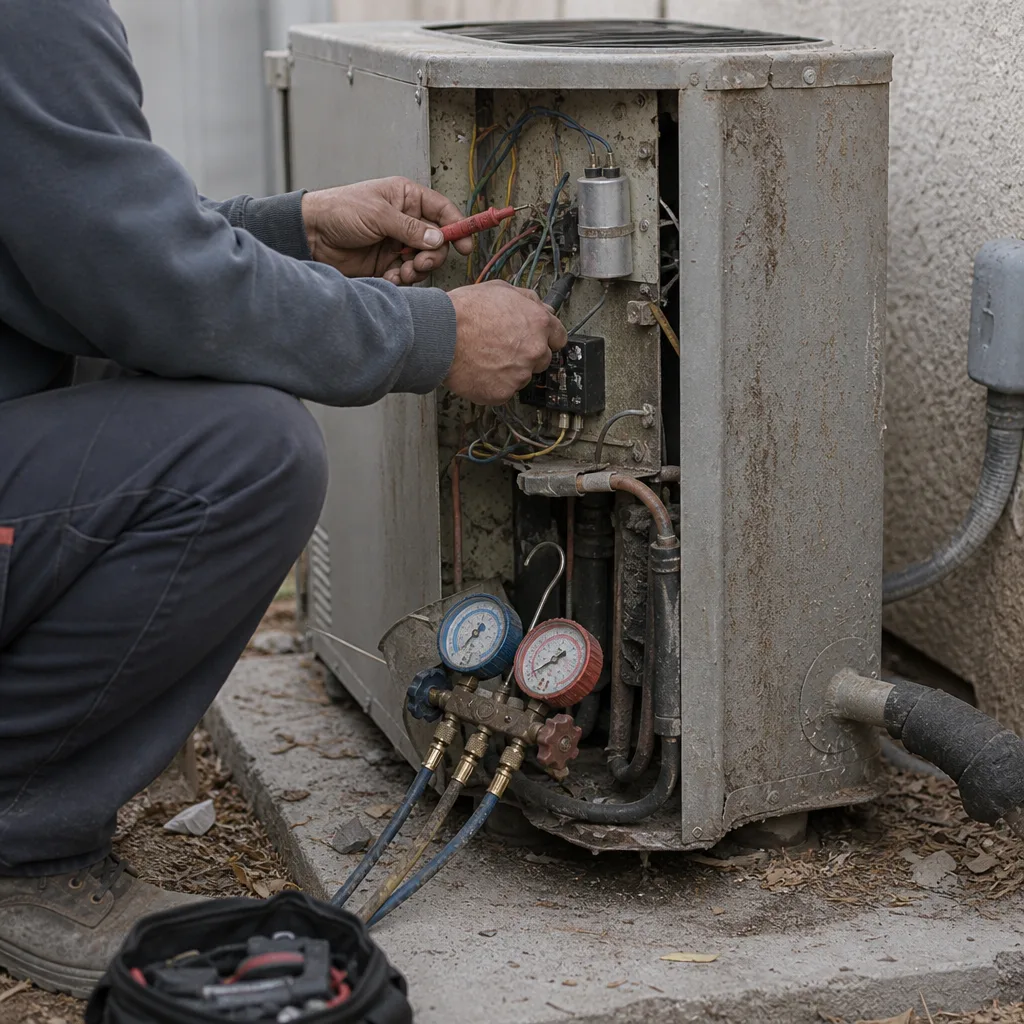 Before
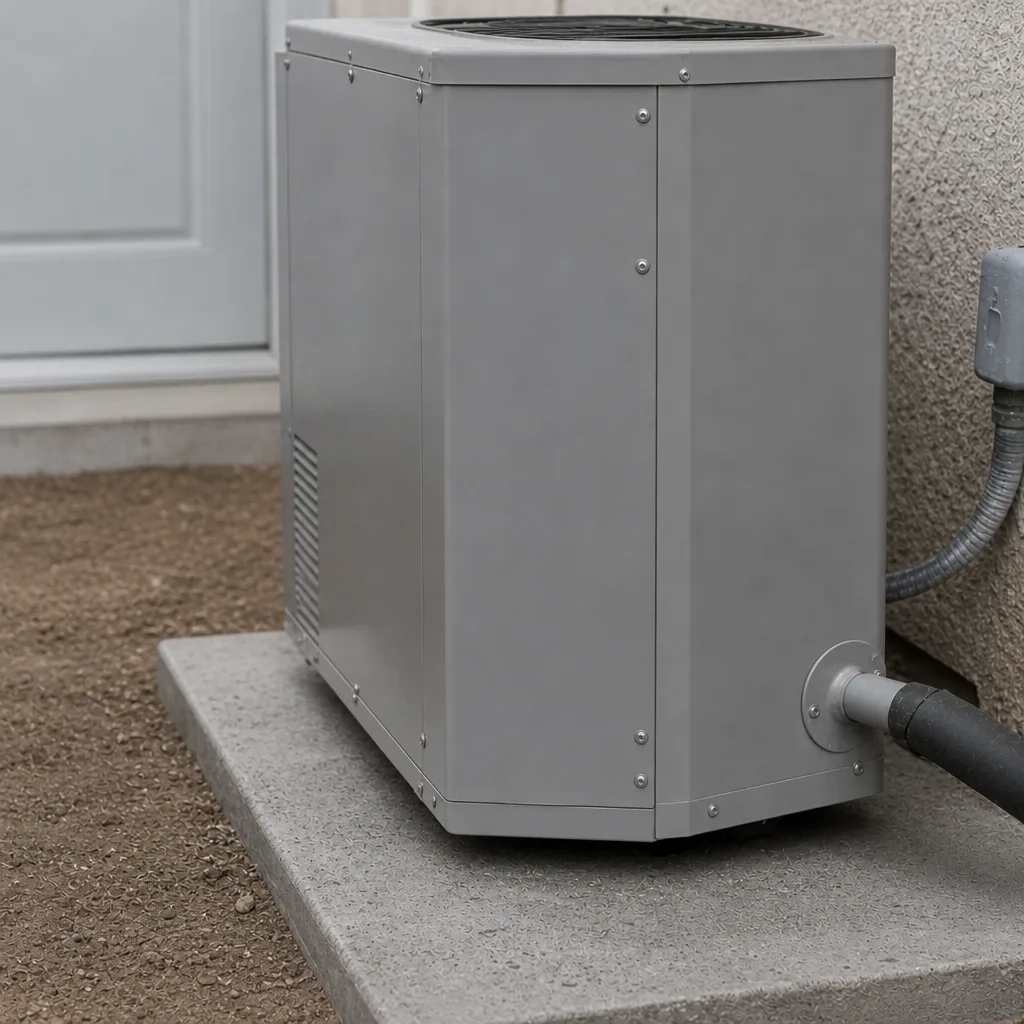 After
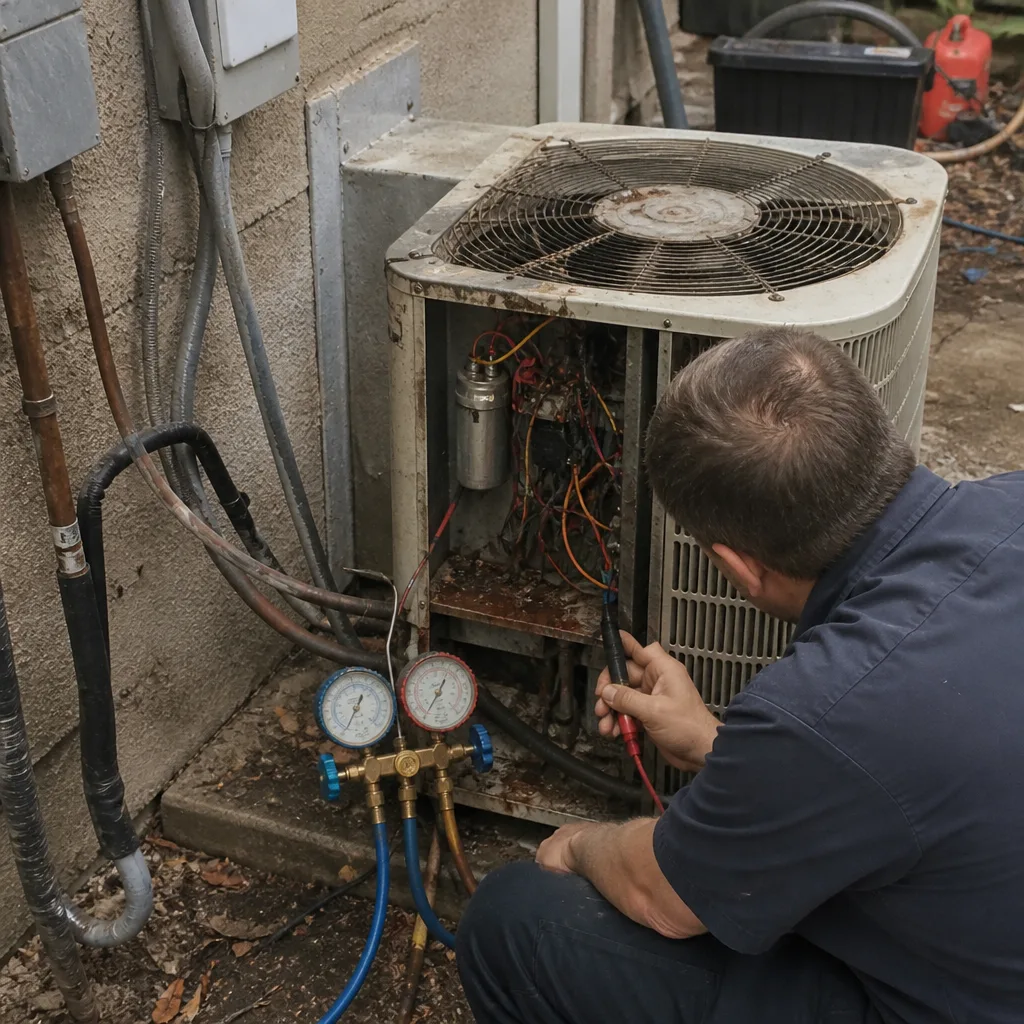 Before
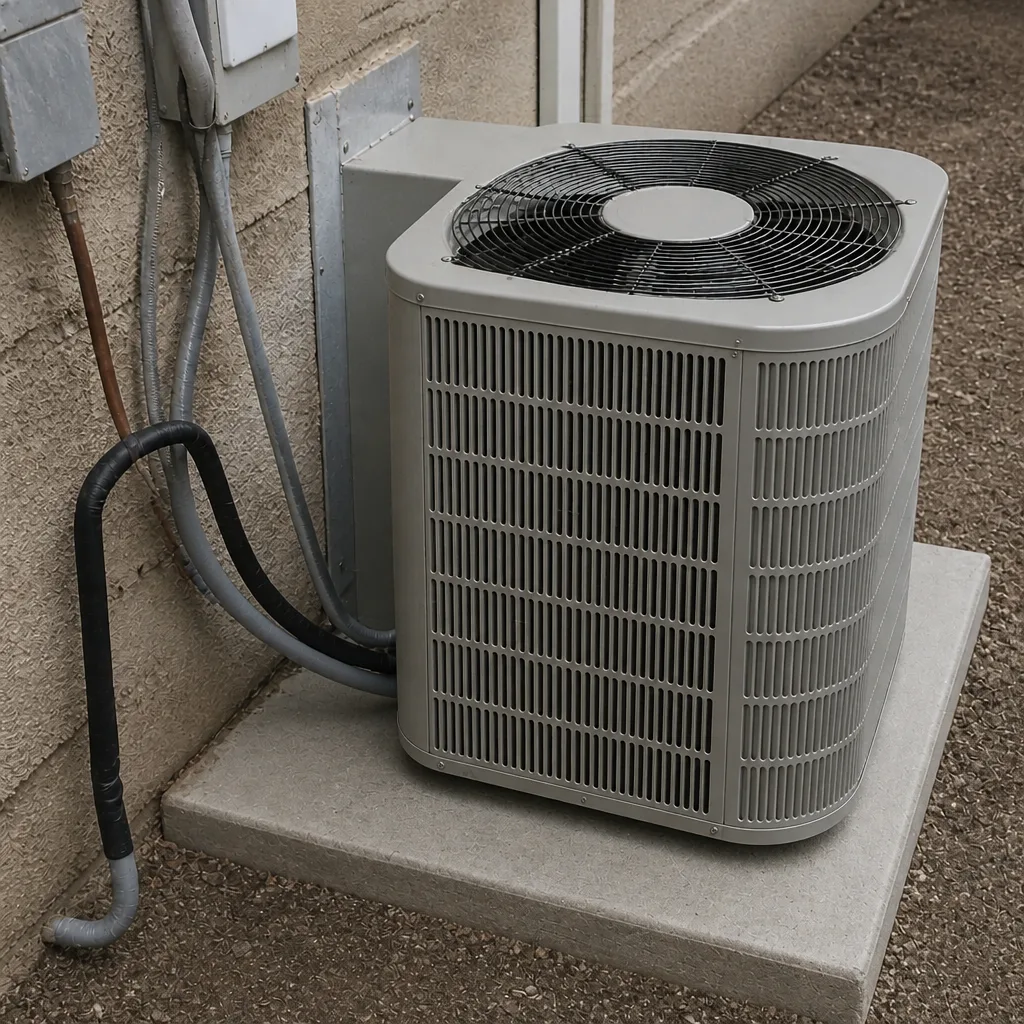 After
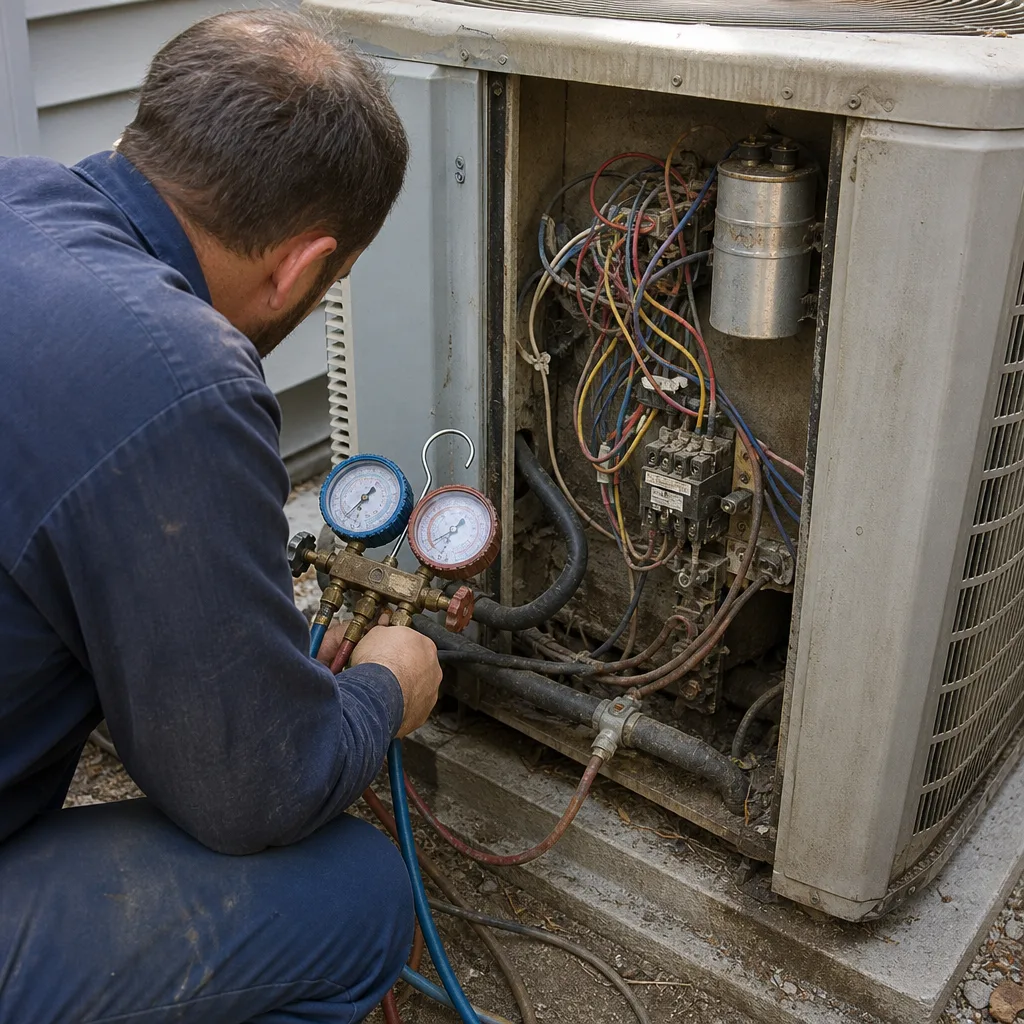 Before
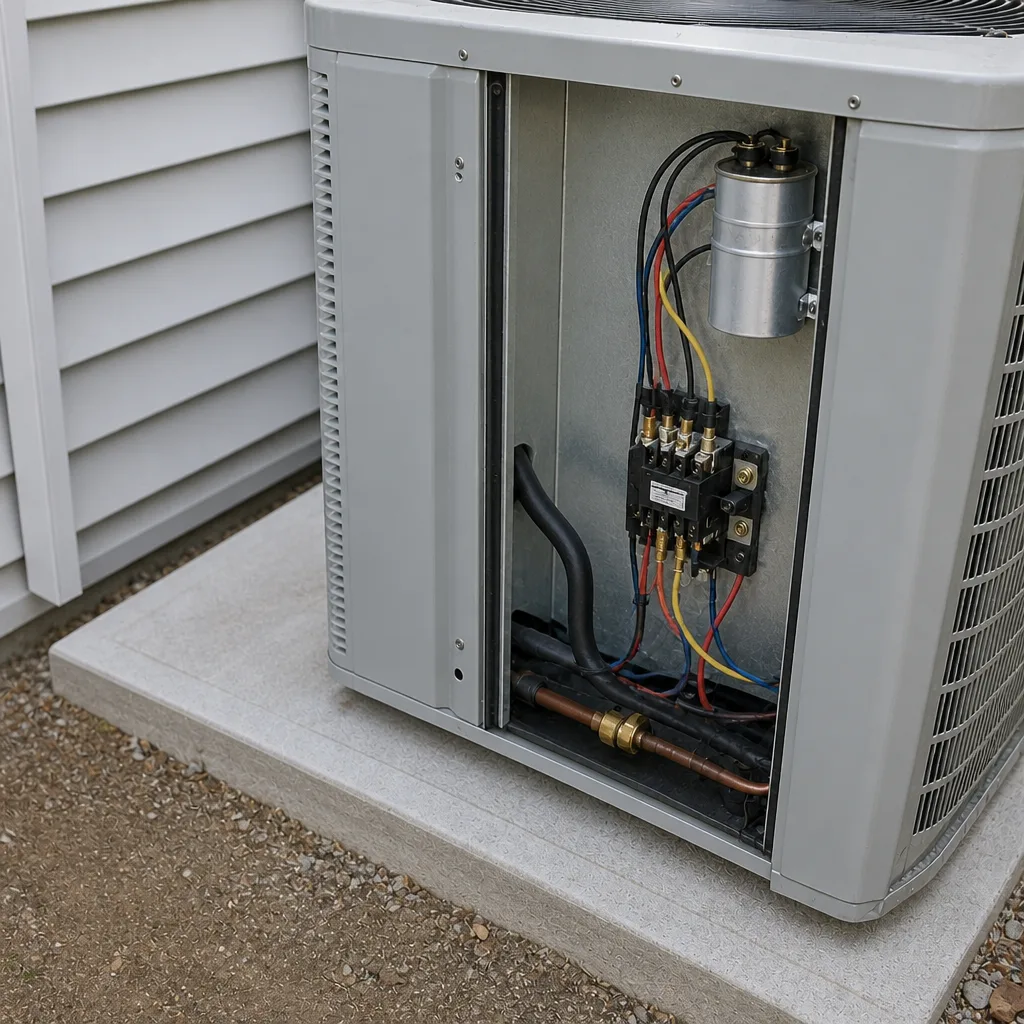 After
Frequently Asked Questions
Once a year is the minimum, and the right time is March or April, before the cooling season starts. In Enterprise, the dust load from spring construction means a mid-season filter change and a drain-line check between June and August are worth doing too. If you have pets or you’re near active grading, your filter interval should be 30 days from March through June.
Expect $120 to $220 for a seasonal visit that includes a filter, coil check, drain clear, and written readings. Repairs are separate, and the quote should follow a diagnostic, not a phone guess. Call (844) 455-2034 for an exact quote – estimates are free.
The rule we use: if the repair cost exceeds about a third of what a new system would cost and the unit is past 12 years old, replacement usually wins the math. Two big repairs on the same aging system is a strong signal. A free second opinion on any written estimate will tell you where you actually stand.
Short cycling, a weak capacitor found on a meter test, a warm air output, or a system that runs constantly without reaching the set temperature. A dirty blower wheel or a dust-loaded coil causes the same symptoms and gets fixed for far less than a compressor. Get the readings before anyone diagnoses the big-ticket part.
For emergency calls, yes – a live person answers around the clock and we’ll tell you honestly what’s possible on the day. Repair and emergency work move fast. A full system replacement is load-calculated and scheduled, so you get a written fixed price and a set install date rather than a same-day promise that skips the math.
Rebates change with equipment efficiency tiers and the programs available at the time, and a written quote should spell out what applies. We handle the rebate and financing paperwork as part of the replacement process so you see the real cost, not the sticker price. Call (844) 455-2034 to walk through it.
The Bottom Line
A maintenance checklist is only useful if it’s about your house. The generic seventeen-item list on your fridge was written for every climate and every building type, which means it fits none of them well. The Enterprise version is tied to our calendar – coolant checks in March, dust control through the spring construction season, coil and drain work before the July heat. It gives you readings instead of checkmarks. And it tells you when to stop repairing and start replacing. Our technicians have up to 24 years of experience and have seen what fails first in Enterprise, and every visit comes with the 90-Day Done Right Promise in writing. One call brings us back. If you’re not sure where your system stands, start with heating and furnace service in Enterprise, heat pump and mini-split work in Enterprise, or just call and ask. You can reach us at (844) 455-2034 for a free estimate, and the person who answers can be Ray himself.
Written by the team at Ray’s Heating & Air Enterprise.